Saturday, October 25, 2008

In Case of Tsunami

Since the huge tsunami which struck in the Indian Ocean many communities have accelerated their tsunami warning and evacuation route notice programs.  We've seen lots of new signs all along the coast, but this one takes the cake.  If you want to get someone's attention about tsunami evacuation, how about this sign:

Note:  If this is your photo please let me know.

Friday, October 24, 2008

Electoral Map Shows McCain Must Sweep to Win

We've been looking at the poll trends, both nationally and in the key or battleground states.  For all the interesting trends and underlying possibilities that could shape the last ten days of the campaign, there is one perspective that is perhaps the most predictive of the ultimate outcome, and that is the status of the electoral college.  As of today's polls, McCain is over 110 electoral votes short of the 270 needed to be elected.  Obama has about 35-40 more votes than are required.  Now the voters may still shift, and do so dramatically - even a six or seven point shift is possible with the leading candidate under 50% - but as a practical matter this shift would have to be a perfect sweep for McCain to win the Presidency.  That is to say that he would have to win all of the battleground states, and one or two currently leaning Obama.  Obama, on the other hand, need only win one - Colorado or Florida or Virginia or...well, the point is that though it is still a possibility that McCain could win, and a likelihood that the race will be even closer than it is today, it is a very long shot that he could run the table.  Bookmakers are estimating the probability at 83% that Obama will win, and it is this electoral college situation that makes an Obama victory seem so likely.  Even if McCain comes from well back in the last ten days, and wins all but one of the states called battleground states, he'd still fall short of the required 270 electoral votes.  In short, McCain must win every toss-up and battleground state.  Now that, is a tall order.  MB

Thursday, October 23, 2008

Is the 2008 Election Still Within Reach for McCain/Palin?

Whether the polls are nearer to three or seven nationally, the electoral map has been changing dramatically over the last month.  Karl Rove regularly publishes maps with his call on the state polls and the electoral status.  Below is the latest electoral college race according to Karl Rove: 

Electoral Map

I mentioned in an earlier post that the race seems to have some similarities to the 1980 election - one where the voters made up their mind over the last weekend that they were indeed comfortable with Ronald Reagan.  It occurs to me that it may also be like the 1948 election, where Truman was trailing by seven points with one week remaining in the campaign, and on election day the voters ultimately decided they were not as comfortable with Dewey as with the experienced Truman. 

Of course, many of these questions are driven by the perceptions underlying the overall preferences of voters for a candidate.  In that next layer of poll data we learn more about why they are leaning and choosing as they are, and we see trends that make the race fluid.  What we don't know is how high the tide will be on November 4, and in fact, which underlying trends will be lifted with whatever tide rises.  

Wednesday, October 22, 2008

More close polls and slanted news coverage?

More polls show a tightening race - Gallup Traditional shows Obama regaining 5 point lead

Today the AP-GfK released its latest poll.  It shows John McCain and Barack Obama essentially running even among likely voters in the election homestretch, with Obama at 44 percent and McCain at 43 percent, well within the margin of error. Just three weeks ago, this survey found that Obama had surged to a seven-point lead over McCain.

The IBD/TIPP Poll shows Obama's lead is down to 3.7 from 6.0. McCain gained ground in the West and with independents, married women, as well as gaining momentum in the suburbs, where he's gone from even a week ago to a 20-point lead. Obama added gains in urban areas and with lower-class households, but he slipped 4 points with parents. (IBD's polling partner, TIPP, was the most accurate pollster of the campaign season for the 2004 election.)

The latest Gallup Traditional Poll shows Obama stretching his lead back to 5 points from a recent low of 2.7%, while the Real Clear Politics average has moved back up to about 7% from a low of just over 5% on Monday. 

It is clear that McCain made some gains in the period after the third debate, though it is less clear how much he has gained, and if the increase has already peaked.  I still have some questions about how late-breaking voters will go - Obama is still running at just 52% 'ready to be President' compared to McCain's 80%, so it may be that late-breaking undecideds will ultimately decide that he is ready, or it may be that they won't reach that tipping point and will go for McCain based on his experience.  It is one reason that you'll see Obama exhorting crowds to vote early in his current stump speech. 

MEDIA Coverage Comparison - McCain stories overwhelmingly negative, according to Project for Excellence in Journalism study

The media coverage of the race for president has not so much cast Barack Obama in a favorable light as it has portrayed John McCain in a substantially negative one, according to a new study of the media since the two national political conventions ended.

Press treatment of Obama has been somewhat more positive than negative, but not markedly so. 

But coverage of McCain has been heavily unfavorable—and has become more so over time. In the six weeks following the conventions through the final debate, unfavorable stories about McCain outweighed favorable ones by a factor of more than three to one—the most unfavorable of all four candidates—according to the study by the Pew Research Center’s Project for Excellence in Journalism.

For Obama during this period, just over a third of the stories were clearly positive in tone (36%), while a similar number (35%) were neutral or mixed. A smaller number (29%) were negative.

For McCain, by comparison, nearly six in ten of the stories studied were decidedly negative in nature (57%), while fewer than two in ten (14%) were positive.

All of this makes me wonder if the media that seems to be favoring Obama in how he is reported are somehow tweaking the sense of fairness among viewers/readers with the overwhelmingly negative coverage? 

Tuesday, October 21, 2008

A Couple of Notes from Today on the Campaign Trail

Today I've witnessed two rather blatant examples of the kind of character assassination and ordinary meanness that has come to characterize politics and this campaign:

First, Barack Obama is taking part of two days off from campaigning to go to Hawaii. Now when I first heard this as a headline I thought, "Wow". Then a few minutes later I heard the details. He is going to visit his grandmother - the woman who virtually raised him - at her home. She has been ill lately, and broker her hip just last week.

So how does this show rancorous campaign behavior? Well, think about the headline I heard. It made the trip sound like a vacation, when it is indeed anything but a vacation. But it got worse. During the day I have read and heard comments and questions speculating about whether the trip is a political stunt to make Obama look more human and less detached, or whether he would be visiting his grandmother if he wasn't well ahead in the polls. That people are so focused on defeating the opponent, using every action or statement if a way to use it to discredit can be found. All that needs to be said about Senator Obama's visit to his grandmother is that he is taking two days to spend with his seriously ill grandmother. Period.

Second, I happened upon this gem from Malia Lazu, a Democratic strategist who was appearing on Neil Cavuto's show:

"If you have been lucky, to achieve your dream and it is a lot larger than everyone else, then as an American you should want to babies learn how to read, go to doctors and have schools."

This is an example of a couple things in my mind. Just look at the language she chose to use and you'll see some demagoguery and a clear indication that she views anyone who succeeds financially as having taken advantage of someone to do so. She also manages to use the royal 'should', to tell us that if we are decent people we must view this as she does. Here's what we learn from that brief remark:

1. People who succeed financially are 'lucky'.

2. People who achieve a dream that is a lot larger than everyone else (this tells us that the success described here is excessive).

3. If you are decent, a decent American you should (must) want to pay more taxes for the benefit of others.

4. The demagoguery comes last, where she takes a discussion of what sort of tax policy is best, fair, etc. and introduces the welfare of 'babies'. In other words, if you don't agree with her, even though she has made it clear that decent Americans should, then you must be against babies being educated and healthy.

Nauseating. If I had started out agreeing with her I would have to fight myself not to change my opinion just to avoid being linked in any way with this statement and the beliefs it reveals. She later went on to say that people who have made money have done so "on the backs of others".

So on the one hand, there are people who cannot help themselves and must question whether Obama visiting his ailing Grandmother is a political stunt, while on the other hand we are told that if we don't agree with raising taxes on the highest earners we support sick and uneducated babies. See why I hate the way politics are making us behave? Coarse, base, judgmental and, as Dana Carvey might say, "just a wee bit superior."

Attack Politics Gone too Far

Whatever one thinks of Joe the Plumber's question to Senator Obama, the way he was treated afterward has got to send a small shiver up your spine.  The guy asked a question about his family's financial future of a man running for president.  It is a question many Americans would like to ask.  And because he did this, he has been investigated in great detail.  People have pulled his tax records, his property records, his voting and contributions records.  Reporters have called his company, friends, even some customers for whom he has done work. 

Think about it for a minute.  Because a citizen asked a question of a candidate, he was fair game for reporters to investigate and background.  It was suddenly 'news' to know whether he is a licensed  plumber or simply works under the supervision of one (like many employees of plumbing companies do).  I can only imagine that if he'd been divorced three times, or had a DUI or any other prurient life event had been part of his jacket we'd hear about them as well.  Why?

A private citizen asked a question of a candidate.  The question got videotaped, and then broadcast.  The candidate used a phrase that stuck in the craws of many people, and the question became well-known.  But by the third day after the question was asked, the question was no longer the news.  The answer was no longer the news.  By then, what was really important about the matter was Joe.  Is he qualified to ask a question?  Did he trick the candidate?  Is he someone with nefarious intent?  Does he wear boxers or briefs?  Yes, the focus was very quickly removed from a substantive question and a meaningful answer to an inquest into the character of the citizen who had the temerity to ask it. 

For the record, I don't see anything wrong with the question OR the answer.  Government already 'spreads the wealth around' to a degree, and one key question before the voters is 'should government redistribute money from the wealthy to the poor' to a greater degree than at present.  You see, the Obama campaign feared that phrase not because it misrepresented what Obama wants to do, but because it was artlessly phrased and might hurt him in the polls.  McCain's campaign gleefully glommed onto it and announced that it makes Obama socialist.  We ALREADY do this, folks.  The question is not whether our society redistributes wealth.  The question is how much, and how?  And the fact that some guy that asked a perfectly meaningful and reasonable question came under attack from one side and was used as a prop by the other says as much as any other example about what is wrong with us in general and what is wrong with campaigns in particular.

I am saddened that we live now in a place where if I disagree with you on some matter, before long that disagreement is seen as justification to put my life and character on trial in the court of public opinion.  What is disturbing isn't just this, though, it is that the character bashing is used to deflect and halt examination and discussion of the real issue raised, which in this case was should we take earnings from people making over a certain amount to give to people of low income in various ways?  Rational human beings can make arguments and hold genuine beliefs from either side of that question.  Instead, we attack the guy that asked it and go back to labeling and name-calling.  The questioner becomes the story and the two sides of his question are lost in the new cliches shouted from the wings onto the electoral stage: "Socialist!" yells the right, while from the left come cries "tax breaks for the rich while the poor starve!".  And news vans park in front of Joe's house and sift through his garbage. 

Is there really anyone reading this that doesn't get why I am so sick of our politics and the direction public discourse is heading in America?

Sunday, October 19, 2008

Polls Show Tightening Race

Beginning just two days ago a trend began that seems to indicate that the gap between Barrack Obama and John McCain is shrinking. Zogby released the latest poll (October 19), with Obama leading McCain by just 2.7% - within the 2.9 % margin of error. This follows the Gallup traditional voters poll, which was the first to show this recent trend.

In the battleground states, the most recent poll shows Obama's lead shrinking by one-fifth (down 1% from 5% to 4%) since last week, and that the bulk of the uptick for McCain is coming from the still-undecided voters.  The total undecided voter group dropped by 1%, about the gain McCain is posting.

The Rasmussen poll shows Obama holding a fairly steady five point lead, and that while most Americans feel that tax cuts are the most important thing that can be done to help the economy, many also feel that raising taxes on 'the rich' is not a bad idea.

So, if the race ended today? The oddsmakers line has Obama at 83% probability of winning. My questions:

Will McCain continue to trend upward?

Will undecided voters feel comfortable with what they know of Senator Obama as they near the election day and reach their 'tipping point'?

Will there be any Bradley effect?

For someone very tired of the coarse, abrasive and intentionally misleading campaign, looking at the many elements of public opinion and perspective is a welcome refuge from the mudslinging.

Thursday, October 16, 2008

Closer than it Seemed?

The Gallup likely voter poll for today shows that likely voters are breaking toward McCain as the election nears. Today's poll of likely voters shows Obama leading McCain 49 to 47 - a four point improvement for McCain since Tuesday and within the margin of error for the poll.

Readers of this blog will recall that I have been wondering if this race would close up as the election neared and if undecided voters would ultimately decide they feel comfortable with Senator Obama. It will be interesting to see if Zogby, Rasmussen end up with a similar McCain bounce this week, and what kind of coverage the poll gets in the media. Obama supporters have only to recall the lost momentum late in the primary campaign as Hillary Clinton came back from the dead and Obama was able to hold the nomination only because he'd built such a margin early on.

As I speculated in an earlier post: is his lead large enough, and are people 'sold' on this candidate? It would give me concern if my candidate had a history of soft-polling to be within four or five points heading into the election weekend. Add to that the other issues that may or may not be real issues in the voting booth, and I would think the Obama campaign must be quietly nervous behind closed doors.

Still, it is just one poll right now, so we'll have to keep a weather eye for Zogby and Rassmussen, et al, over the next few days.

That isn't Fair!

"Expecting the world to treat you fairly
because you are a good person
is a little like expecting the bull not to attack you
because you are a vegetarian." --Dennis Wholey

"That isn't fair!" I am often surprised at myself when I use this phrase. I am even more often surprised with others when they say something along those lines. It is not surprising coming from children, I suppose, for as children we have not yet learned the truth about fairness. As children we can still yet believe that fairness will govern our lives, though it doesn't take many formative years to begin bruising that belief. Usually it is adults that surprise me when they speak of things being fair or unfair. Of course, I understand our desire to apply fairness as a concept to our lives, but by now most of us have realized that fairness is more the exception than the rule. Fairness is an ideal, it is something to strive for, but for the most part it is only an external and subjective judgement and not a governing property. More simply put, fairness is something we all wish for, and many of us strive for, but most of the time life isn't fair.

Perhaps this impulse is vestigial; a soft lingering whisper down the years from our childhood to our adulthood. As parents we often tell our children to 'play fair'. And we should, no doubt. But as parents we also watch our children come gradually to the same dawning practical realization - life ain't fair. There are bullies in this world. Some kids are smarter than others. Some don't have enough food or a warm coat and others think nothing of wasting extravagant quantities of everything. There is cancer and war and natural disaster. There is crime and abuse. And no matter what some television evangelist says, bad things happen to good people too. If the wages of sin are death, it is just as sure that the wages of life are inequity. Life ain't fair.

Yet when I listen to the words people choose when discussing events in their life, it is surprising how often I hear people express surprise and even shock at how unfair life can be. On some level, despite intellectual awareness that life cannot be fair, we hold on to a belief that it is. We express surprise when life is not fair to us or others, and if the issue is upsetting enough we organize to protest or raise money to fight back, or try to pass legislation that mandates fairness. Though we know in our hearts that life ain't fair, we feel a strong need to fight for fairness. What kind of world would we live in if we could not even cling to the hope that life will deal fairly with us?

It seems to me that this dichotomy in our zeitgeist is healthy in the abstract. It gives us hope, and allows us to balance our perspective between a grim realism and a grounded optimism. The idea that we can expect life to be fair is so clearly wrong that many of the big disappointments in life have such an impact because we expect 'fair' treatment when we can have no reasonable expectation of fairness. But at the same time, were we to choose to expect life always to be unfair we'd probably never leave the house. Somewhere there is a good balance between the realistic awareness that fairness is not to be expected and the hopeful expectation that people will at least try to be fair to one another. And in practice, the only fairness we can really bring about is our own fair treatment of others.

"You must be the change you wish to see in the world." --Mahatma Gandhi

Tuesday, October 14, 2008

Old Wisdom, Fresh Today

The budget should be balanced. Public debt should be reduced. The arrogance of officialdom should be tempered, and assistance to foreign lands should be curtailed, lest Rome become bankrupt.
--Marcus Tullius Cicero

I also thought about this, the greatest Roman orator, a man that believed that good and evil were always good or always evil. Unlike the Sophists of the past, who believed essentially that the truth is whatever the speaker can convince the audience is true, Cicero believed that the truth was constant, and rhetoric was to be used only to illuminate truth.

When you watch campaign events and the 'talking heads' representing both parties, do you get the feeling they are illuminating the truth? When I consider that question it is clear enough to me that our politics are closer to the sophist than to Cicero. The sophist routinely used ad hominem arguments, intent upon winning an argument by diminishing an opponent in the eyes of the jury or audience, rather than on the merits of the matter under consideration. Sound like any speakers we can think of today? To me, both donkeys and elephants make full-time use of the sophist approach. Attack the other guy, muddy the waters, make yourself look good by tearing the other person down. I honestly don't see how anyone watching the political campaigns today could disagree.

Monday, October 13, 2008

Never Be Afraid

Never be afraid

Sunday, October 12, 2008

Never Say Die: Why We Can't Imagine Death

This is a fascinating article whatever your beliefs about the soul, and about life after death.  I am particularly interested in the fact that every human culture has a tradition about life after death.  One school of thought is that all such feeling is merely a facet of terror management designed to protect us from the crippling anxiety of non-existence.  It is interesting to note, though, that this belief that we continue on in some way begins well earlier in life than we show consciousness of our own mortality.  Very interesting and thought-provoking article. 

Scientific American Mind -  October 22, 2008

Why so many of us think our minds continue on after we die

By Jesse Bering

Everybody’s wonderin’ what and where they all came from.
Everybody’s worryin’ ’bout where they’re gonna go when the whole thing’s done.
But no one knows for certain and so it’s all the same to me.
I think I’ll just let the mystery be.

It should strike us as odd that we feel inclined to nod our heads in agreement to the twangy, sweetly discordant folk vocals of Iris Dement in “Let the Mystery Be,” a humble paean about the hereafter. In fact, the only real mystery is why we’re so convinced that when it comes to where we’re going “when the whole thing’s done,” we’re dealing with a mystery at all. After all, the brain is like any other organ: a part of our physical body. And the mind is what the brain does—it’s more a verb than it is a noun. Why do we wonder where our mind goes when the body is dead? Shouldn’t it be obvious that the mind is dead, too?

And yet people in every culture believe in an afterlife of some kind or, at the very least, are unsure about what happens to the mind at death. My psychological research has led me to believe that these irrational beliefs, rather than resulting from religion or serving to protect us from the terror of inexistence, are an inevitable by-product of self-consciousness. Because we have never experienced a lack of consciousness, we cannot imagine what it will feel like to be dead. In fact, it won’t feel like anything—and therein lies the problem.

The common view of death as a great mystery usually is brushed aside as an emotionally fueled desire to believe that death isn’t the end of the road. And indeed, a prominent school of research in social psychology called terror management theory contends that afterlife beliefs, as well as less obvious beliefs, behaviors and attitudes, exist to assuage what would otherwise be crippling anxiety about the ego’s inexistence.

According to proponents, you possess a secret arsenal of psychological defenses designed to keep your death anxiety at bay (and to keep you from ending up in the fetal position listening to Nick Drake on your iPod). My writing this article, for example, would be interpreted as an exercise in “symbolic immortality”; terror management theorists would likely tell you that I wrote it for posterity, to enable a concrete set of my ephemeral ideas to outlive me, the biological organism. (I would tell you that I’d be happy enough if a year from now it still had a faint pulse.)

Yet a small number of researchers, including me, are increasingly arguing that the evolution of self-consciousness has posed a different kind of problem altogether. This position holds that our ancestors suffered the unshakable illusion that their minds were immortal, and it’s this hiccup of gross irrationality that we have unmistakably inherited from them. Individual human beings, by virtue of their evolved cognitive architecture, had trouble conceptualizing their own psychological inexistence from the start.

Curiously Immortal
The problem applies even to those who claim not to believe in an afterlife. As philosopher and Center for Naturalism founder Thomas W. Clark wrote in a 1994 article for the Humanist:

Here ... is the view at issue: When we die, what’s next is nothing; death is an abyss, a black hole, the end of experience; it is eternal nothingness, the permanent extinction of being. And here, in a nutshell, is the error contained in that view: It is to reify nothingness—make it a positive condition or quality (for example, of “blackness”)—and then to place the individual in it after death, so that we somehow fall into nothingness, to remain there eternally.

Consider the rather startling fact that you will never know you have died. You may feel yourself slipping away, but it isn’t as though there will be a “you” around who is capable of ascertaining that, once all is said and done, it has actually happened. Just to remind you, you need a working cerebral cortex to harbor propositional knowledge of any sort, including the fact that you’ve died—and once you’ve died your brain is about as phenomenally generative as a head of lettuce. In a 2007 article published in the journal Synthese, University of Arizona philosopher Shaun Nichols puts it this way: “When I try to imagine my own non-existence I have to imagine that I perceive or know about my non-existence. No wonder there’s an obstacle!”

This observation may not sound like a major revelation to you, but I bet you’ve never considered what it actually means, which is that your own mortality is unfalsifiable from the first-person perspective. This obstacle is why writer Johann Wolfgang von Goethe allegedly remarked that “everyone carries the proof of his own immortality within himself.”

Even when we want to believe that our minds end at death, it is a real struggle to think in this way. A study I published in the Journal of Cognition and Culture in 2002 reveals the illusion of immortality operating in full swing in the minds of undergraduate students who were asked a series of questions about the psychological faculties of a dead man.

Richard, I told the students, had been killed instantaneously when his vehicle plunged into a utility pole. After the participants read a narrative about Richard’s state of mind just prior to the accident, I queried them as to whether the man, now that he was dead, retained the capacity to experience mental states. “Is Richard still thinking about his wife?” I asked them. “Can he still taste the flavor of the breath mint he ate just before he died? Does he want to be alive?”

You can imagine the looks I got, because apparently not many people pause to consider whether souls have taste buds, become randy or get headaches. Yet most gave answers indicative of “psychological continuity reasoning,” in which they envisioned Richard’s mind to continue functioning despite his death. This finding came as no surprise given that, on a separate scale, most respondents classified themselves as having a belief in some form of an afterlife.

What was surprising, however, was that many participants who had identified themselves as having “extinctivist” beliefs (they had ticked off the box that read: “What we think of as the ‘soul,’ or conscious personality of a person, ceases permanently when the body dies”) occasionally gave psychological-continuity responses, too. Thirty-two percent of the extinctivists’ answers betrayed their hidden reasoning that emotions and desires survive death; another 36 percent of their responses suggested the extinctivists reasoned this way for mental states related to knowledge (such as remembering, believing or knowing). One particularly vehement extinctivist thought the whole line of questioning silly and seemed to regard me as a numbskull for even asking. But just as well—he proceeded to point out that of course Richard knows he is dead, because there’s no afterlife and Richard sees that now.

So why is it so hard to conceptualize inexistence anyway? Part of my own account, which I call the “simulation constraint hypothesis,” is that in attempting to imagine what it’s like to be dead we appeal to our own background of conscious experiences—because that’s how we approach most thought experiments. Death isn’t “like” anything we’ve ever experienced, however. Because we have never consciously been without consciousness, even our best simulations of true nothingness just aren’t good enough.

For us extinctivists, it’s kind of like staring into a hallway of mirrors—but rather than confronting a visual trick, we’re dealing with cognitive reverberations of subjective experience. In Spanish philosopher Miguel de Unamuno’s 1913 existential screed, The Tragic Sense of Life, one can almost see the author tearing out his hair contemplating this very fact. “Try to fill your consciousness with the representation of no-consciousness,” he writes, “and you will see the impossibility of it. The effort to comprehend it causes the most tormenting dizziness.”

Wait, you say, isn’t Unamuno forgetting something? We certainly do have experience with nothingness. Every night, in fact, when we’re in dreamless sleep. But you’d be mistaken in this assumption. Clark puts it this way (emphasis mine): “We may occasionally have the impression of having experienced or ‘undergone’ a period of unconsciousness, but, of course, this is impossible. The ‘nothingness’ of unconsciousness cannot be an experienced actuality.”

If psychological immortality represents the intuitive, natural way of thinking about death, then we might expect young children to be particularly inclined to reason in this way. As an eight-year-old, I watched as the remains of our family’s golden retriever, Sam, were buried in the woods behind our house. Still, I thought Sam had a mind capable of knowing I loved her and I was sorry I didn’t get to say goodbye. That Sam’s spirit lived on was not something my parents or anyone else ever explicitly pointed out to me. Although she had been reduced to no more than a few ounces of dust, which was in turn sealed in a now waterlogged box, it never even occurred to me that it was a strange idea.

Yet if you were to have asked me what Sam was experiencing, I probably would have muttered something like the type of answers Gerald P. Koocher reported hearing in a 1973 study published in Developmental Psychology. Koocher, then a doctoral student at the University of Missouri–Columbia and later president of the American Psychological Association, asked six- to 15-year-olds what happens when you die. Consistent with the simulation-constraint hypothesis, many answers relied on everyday experience to describe death, “with references to sleeping, feeling ‘peaceful,’ or simply ‘being very dizzy.’ ”

A Mind-Body Disconnect
But Koocher’s study in itself doesn’t tell us where such ideas come from. The simulation-constraint hypothesis posits that this type of thinking is innate and unlearned. Fortunately, this hypothesis is falsifiable. If afterlife beliefs are a product of cultural indoctrination, with children picking up such ideas through religious teachings, through the media, or informally through family and friends, then one should rationally predict that psychological-continuity reasoning increases with age. Aside from becoming more aware of their own mortality, after all, older kids have had a longer period of exposure to the concept of an afterlife.

In fact, recent findings show the opposite developmental trend. In a 2004 study reported in Developmental Psychology, Florida Atlantic University psychologist David F. Bjorklund and I presented 200 three- to 12-year-olds with a puppet show. Every child saw the story of Baby Mouse, who was out strolling innocently in the woods. “Just then,” we told them, “he notices something very strange. The bushes are moving! An alligator jumps out of the bushes and gobbles him all up. Baby Mouse is not alive anymore.”

Just like the adults from the previously mentioned study, the children were asked about dead Baby Mouse’s psychological functioning. “Does Baby Mouse still want to go home?” we asked them. “Does he still feel sick?” “Can he still smell the flowers?” The youngest children in the study, the three- to five-year-olds, were significantly more likely to reason in terms of psychological continuity than children from the two older age groups were.

But here’s the really curious part. Even the preschoolers had a solid grasp on biological cessation; they knew, for example, that dead Baby Mouse didn’t need food or water anymore. They knew he wouldn’t grow up to be an adult mouse. Heck, 85 percent of the youngest kids even told us that his brain no longer worked. Yet most of these very young children then told us that dead Baby Mouse was hungry or thirsty, that he felt better or that he was still angry at his brother.

One couldn’t say that the preschoolers lacked a concept of death, therefore, because nearly all of the kids realized that biological imperatives no longer applied after death. Rather they seemed to have trouble using this knowledge to theorize about related mental functions.

From an evolutionary perspective, a coherent theory about psychological death is not necessarily vital. Anthropologist H. Clark Barrett of the University of California, Los Angeles, believes instead that understanding the cessation of “agency” (for example, that a dead creature isn’t going to suddenly leap up and bite you) is probably what saved lives (and thus genes). According to Barrett, comprehending the cessation of the mind, on the other hand, has no survival value and is, in an evolutionary sense, unnecessary.

In a 2005 study published in the journal Cognition, Barrett and psychologist Tanya Behne of the University of Manchester in England reported that city-dwelling four-year-olds from Berlin were just as good at distinguishing sleeping animals from dead ones as hunter-horticulturalist children from the Shuar region of Ecuador were. Even today’s urban children appear tuned in to perceptual cues signaling death. A “violation of the body envelope” (in other words, a mutilated carcass) is a pretty good sign that one needn’t worry about tiptoeing around.

The Culture Factor
On the one hand, then, from a very early age, children realize that dead bodies are not coming back to life. On the other hand, also from a very early age, kids endow the dead with ongoing psychological functions. So where do culture and religious teaching come into the mix, if at all?

In fact, exposure to the concept of an afterlife plays a crucial role in enriching and elaborating this natural cognitive stance; it’s sort of like an architectural scaffolding process, whereby culture develops and decorates the innate psychological building blocks of religious belief. The end product can be as ornate or austere as you like, from the headache-inducing reincarnation beliefs of Theravada Buddhists to the man on the street’s “I believe there’s something” brand of philosophy—but it’s made of the same brick and mortar just the same.

In support of the idea that culture influences our natural tendency to deny the death of the mind, Harvard University psychologist Paul Harris and researcher Marta Giménez of the National University of Distance Education in Spain showed that when the wording in interviews is tweaked to include medical or scientific terms, psychological-continuity reasoning decreases. In this 2005 study published in the Journal of Cognition and Culture, seven- to 11-year-old children in Madrid who heard a story about a priest telling a child that his grandmother “is with God” were more likely to attribute ongoing mental states to the decedent than were those who heard the identical story but instead about a doctor saying a grandfather was “dead and buried.”

And in a 2005 replication of the Baby Mouse experiment published in the British Journal of Developmental Psychology, psychologist David Bjorklund and I teamed with psychologist Carlos Hernández Blasi of Jaume I University in Spain to compare children in a Catholic school with those attending a public secular school in Castellón, Spain. As in the previous study, an overwhelming majority of the youngest children—five- to six-year-olds—from both educational backgrounds said that Baby Mouse’s mental states survived. The type of curriculum, secular or religious, made no difference. With increasing age, however, culture becomes a factor—the kids attending Catholic school were more likely to reason in terms of psychological continuity than were those at the secular school. There was even a smattering of young extinctivists in the latter camp.

Free Spirits
The types of cognitive obstacles discussed earlier may be responsible for our innate sense
of immortality. But although the simulation-constraint hypothesis helps to explain why so many people believe in something as fantastically illogical as an afterlife, it doesn’t tell us why people see the soul unbuckling itself from the body and floating off like an invisible helium balloon into the realm of eternity. After all, there’s nothing to stop us from having afterlife beliefs that involve the still active mind being entombed in the skull and deliriously happy. Yet almost nobody has such a belief.

Back when you were still in diapers, you learned that people didn’t cease to exist simply because you couldn’t see them. Developmental psychologists even have a fancy term for this basic concept: “person permanence.” Such an off-line social awareness leads us to tacitly assume that the people we know are somewhere doing something. As I’m writing this article in Belfast, for example, my mind’s eye conjures up my friend Ginger in New Orleans walking her poodle or playfully bickering with her husband, things that I know she does routinely.

As I’ve argued in my 2006 Behavioral and Brain Sciences article, “The Folk Psychology of Souls,” human cognition is not equipped to update the list of players in our complex social rosters by accommodating a particular person’s sudden inexistence. We can’t simply switch off our person-permanence thinking just because someone has died. This inability is especially the case, of course, for those whom we were closest to and whom we frequently imagined to be actively engaging in various activities when out of sight.

And so person permanence may be the final cognitive hurdle that gets in the way of our effectively realizing the dead as they truly are—infinitely in situ, inanimate carbon residue. Instead it’s much more “natural” to imagine them as existing in some vague, unobservable locale, very much living their dead lives.

Note: This article was originally printed with the title, "The End?"

Saturday, October 11, 2008

Old Friends

I am at a point in my life where I have changed a great deal from the personality I had earlier in life. Until a few years ago, I was gregarious and outgoing in all situations. I made friends often and enjoyed spending time with people more than anything else. I still seem to base my enjoyment of activities much more on who I am with than what we are doing.

Over the past ten years, a number of factors have contributed to shift my personality quite a bit. Heavy travel and long hours at work were part of it, some health issues were part of it, and becoming a parent is part of it. Now, I find that I spend most all of my free time and energy with my kids. I still enjoy people, but the people I enjoy most are enough for me now. We spend our time with the kids, some couples that my wife and I like and enjoy getting together for dinner with now and then, family and some casual friends through school, or the kids sports teams, etc.

But overall, I enjoy solitude more than I did. I enjoy the hour or two of quiet each night after the kids have gone to bed and it is just me and my book. I am seldom the life of the party now, but more often an average guest, neither too reserved or too outgoing. In fact, as the years have passed, I have come to value my old friends even more - and I always valued them pretty highly. By old friends, I mean the friends I made as a teenager and still keep in touch with 35 years later. Something about old friends, or maybe just these old friends, is so essentially different than the friends we've made more recently. Old friends don't have to figure you out. They don't just see part of your life. The context of those friendships began before I'd accomplished anything, failed at anything much, had big and small, great and rotten jobs, married, divorced, had children. But also, it is the context of having shared each of those developments and stages of life together. Why is it that when you meet with old friends it is as though no time has passed since last you saw them? At least in part it is because you know each other so well, know how each other thinks and feels. I also think it is because a few weeks or a couple months or even a year passing without seeing one another doesn't add up to much time at all compared to the 35 years of friendship between us.

My friends from childhood - five or six of us - keep in touch. We get together, email, call now and then. And I think all of us realize that we are fortunate to have made the effort to maintain our friendships. Down the long years, those friends have become much more than just people we enjoy spending time with. They have become a richness that our lives otherwise would lack. They have become a source of stability, kept us grounded, reminded us of who we are.

I still enjoy people and like to meet and talk with others. But it is a luxury to know that if I never make another friend, I have these good, old friends to carry with me as far into old age as we go. I'll make more friends, I am sure. But I won't ever make better friends.

Thursday, October 09, 2008

Zogby Poll: No Candidate with a Clear Advantage

Zogby International polls have been very successful in predicting the actual outcome of elections, and the data this year indicates that the 2008 Presidential Election may well be decided on the last weekend before the election. He likens this year to 1980 when the race between Jimmy Carter and Ronald Reagan was close until the final weekend, when large numbers of voters broke for Reagan. They apparently became comfortable with him when it came time to actually make a choice - the tipping point. It will be interesting to see if the various poll-related problems with each candidate play out as real factors in this election: For McCain, will the age question tip undecided and independent voters to Obama? Will negative ads about Obama's past associates backfire? Will his war posture ultimately be the electoral burden it was believed to be at the outset of the campaign? For Obama, will he continue a pattern of soft-polling (some people who tell pollsters that they will vote for Obama do not in fact vote for him)? Will predictions made by Stanford researchers that a meaningful percentage of voters (including Democrats) refuse to vote for an African American candidate? Obama has high numbers in the surveys asking if he is unqualified - it has stayed at about 48%, the highest of any candidate since Dukakis. Will a late-breaking electorate ultimately decide he IS qualified, or will this high level of uncertainty ultimately translate to a shift to McCain at the last minute?

Leaving aside the people yelling at each other and calling each other liars, terrorists, mental patients on television, radio and the stump, there is a clear difference in approach in this election. Obama will doubtlessly move left if elected (as did Bill Clinton), and McCain will be faced with an opposition Congress. Both men (regardless of what they tell us), will increase the huge budget deficits, and depending on your beliefs about tax increases they will have different effects on the economy. But, as usual, the ideologues and interest groups are choosing the lowest road available. The name-calling has reached a fever-pitch especially early this year. And my question is this: both men have said they will change Washington. And maybe both really mean to do so. But how can they change Washington when they cannot even change the campaign? Partisan rancor and fighting has taken over the campaign, as usual and maybe worse than usual, so how can either one be expected to really change how government works?

I can't make myself listen to much from the pundits, candidates and campaigns this year, once again. It is rude behavior, and all of it shows a lack of character all around. About the only way I can stomach the campaign is to read the various fact-checking resources to see what the proposals made will really result in, according to independent researchers, and to look at the polls in detail in the manner of an avid baseball fan looking at statistics.

Zogby has the race at 48-44 Obama today, with a margin of +/- 2.9%. Both candidates are holding their partisans (Obama 86% of Democrats and McCain 87% of Republicans), and at the moment Obama is winning the battle for independents (49% to 39%). If John Zogby is right and the election breaks big on the last weekend, it will be interesting to see if people are ultimately able to feel comfortable with Obama, if the racial issue is a factor, and if soft-polling is a factor. It will also be interesting to see if the economic crisis is still the dominant issue, and if McCain, a member of the President's party and therefore traditionally hurt by a bad economy, gets harmed by it. The one wild-card was mentioned today by a Democratic talking head, who said that he feels that unless there is a terrorist attack Obama will win going away.

There are a lot of ingredients in this year's election stew, and it will be interesting to see how they all come together to affect the outcome. Either way, I will be glad not to have to hear people hating on each other publicly, loudly and without inhibition. Just think what we'd say to our kids if they interacted together at school the way people in public act about elections. It feels like the approved method of campaigning has become slander, smear and shout the bastard down. And the electorate so deeply divided that I know people who have stopped being friends because they could not be friends with someone who held 'those' political views. Can't we go back to the good advice of polite society - never discuss politics and religion? Or the advice of Thumper's mother: "If you can't say something nice, don't say anything at all"? One man that was able to work with everyone in the Senate was Alan Simpson, who said, "If you have integrity, nothing else matters. If you don't have integrity, nothing else matters."

I can live with either candidate, no matter how different their approach, as long as they have integrity. I think that one approach may be better than another for most circumstances, (Jimmy Carter had integrity and also had a tough time governing, in my opinion), but knowing that the candidate has integrity would mean a great deal to the public. Now I am not saying that either man lacks personal integrity. But how much of it do they show with the campaigns they run?

Now I know that my opinion is just my opinion, and I know that the only reason you are reading it now is that anyone can read damn near anything on the Internet in the Information Age. Once upon a time, there was an expectation that reading someone's opinion suggested that it was an informed and perhaps an expert opinion. Now, it just implies an Internet connection. The quote: "The irony of the information age is that it has given new respectability to uninformed opinion." by John Lawton applies here. I wouldn't want anyone to think that I hold my own views in exception to this sentiment, I don't. But, that said, I find it to be a satisfying exercise to be able to jot my thoughts, knowing that whether or not anyone actually reads them, someone might.

From the Doctor - Funny stories from physicians

Submitted by Dr. Susan Steinberg
One day I told a wife that her husband had died of a massive myocardial infarct. Not more than five minutes later, I heard her reporting to the rest of the family that he had died of a ‘massive internal fart.’

Submitted by Dr. Leonard Kransdorf, Detroit, MI
I was performing rounds at the hospital one morning and while checking up on a woman I asked, ‘So how’s your breakfast this morning?’ It’s very good, except for the Kentucky Jelly. I can’t seem to get used to the taste,’ the patient replied. I then asked to see the jelly and the woman produced a foil packet labeled ‘KY Jelly.’

Submitted by Dr. Rebecca St. Clair, Norfolk, VA
During a patient’s two week follow-up appointment with his cardiologist, he informed me, his doctor, that he was having trouble withone of his medications. ‘Which one?’ I asked.’The patch. The Nurse told me to put on a new one every six hours and now I’m running out of places to put it!’ I had him quickly undress and discovered what I hoped I wouldn’t see. Yes, the man had over fifty patches on his body! Now the instructions include removal of the old patch before applying anew one.

Submitted by Dr. Mark MacDonald, San Francisco
A man comes into the ER and yells, ‘My wife’s going to have her babyin the cab!’ I grabbed my stuff, rushed out to the cab, lifted the lady’s dress, and began to take off her underwear. Suddenly I noticed that there were several cabs, and I was in the wrong one.

Submitted by Dr. Steven Swanson, Corvallis, OR
While acquainting myself with a new elderly patient, I asked, ‘How long have you been bedridden?’ After a look of complete confusion she answered, ‘Why, not for about twenty years, when my husband was alive.’

Wednesday, October 08, 2008

Fatherhood

I'm continually surprised by my kids.  Most parents are, I know, and not always in good ways.  I have been fortunate in my life to have a pretty great time with good friends, interesting work and lots of interests.  Still, looking back I realize that there is an entirely new dimension to my life since I became a father and it has changed everything about me. 

I once thought of myself based on where I was from, or what I did for a living, or my world view ideologically.  I realized the other day that the first thing that comes to my mind now when a situation calls for me to tell someone who I am, is father.  I'm a father.  I choose what I do every day, with every free moment, based on wanting to spend time with my kids, and give them experiences.  I view most situations in life with an eye to making sure they are able to understand what is happening.  I feel cheated if I don't get to put them to bed, and never miss an event if I can help it.  They make me laugh often, and it is conversations with them in the evening that are my treasure. 

None of that is to say that I am a very good father.  I am rather critical of myself as a father.  But it is who I am, and what I want most to be.  I hope my kids never lose the desire to tell me about their day, read with me, take trips together and hang out together.  I know that even as a teen I still wanted to hang out with my own father.  Maybe I will be so lucky. 

Saturday, September 27, 2008

Chronic Sleep Deprivation and Fat

From Psychology Today:


Sleep the Fat Off
There may be a connection between the amount you sleep and your appetite.
By: Carlin Flora

Imagine… shedding pounds simply by spending more time in never-neverland. Sounds like something out of a late-night infomercial.
But two studies show a striking connection between amount of sleep and levels of appetite-regulating hormones in the body. The findings suggest that chronic sleep deprivation could be making you fat.
American adults have cut their average nightly sleep time by nearly two hours in the last 40 years. And while we've lost sleep, we've gained weight: In 1960, only one out of four adults was overweight, and one out of nine was considered obese. Now, two out of three adults are overweight, and nearly one out of three is obese.
Previous research had shown an association between shorter sleep time and higher body mass index, but no one knew why, says Dr. Shahrad Teheri, an endocrinologist at Bristol University, and lead author of one of the two studies.
He and his colleagues used data from the Wisconsin Sleep Cohort, which has tracked the sleep habits of over 1,000 volunteers for 17 years. They found that those people who slumbered (on average) five compared to eight hours each night had a higher body mass index.
And when the researchers collected blood samples from the volunteers, they discovered that the sleep-deprived had higher levels of ghrelin in their blood. Ghrelin is a hormone produced in the stomach that sends out hunger signals to the brain, which then commands you to be interested in food.
At the same time the sleep-deprived had high levels of hunger-stimulating ghrelin, they had lower levels of leptin. Leptin is another appetite-regulating hormone; it's produced by fat cells and delivers satiation signals to the brain. The particular hormonal ratio of high ghrelin/low leptin was likely encouraging the group to load up on unnecessary calories.
"Before this, people thought obesity was the result of sitting on your butt and stuffing your face," Teheri says. "But it turns out sleep has an influence. It makes sense to me personally, because when I was a sleep-deprived resident, I always had the munchies."
The second study hails from the University of Chicago's sleep laboratory. It shows that sleep loss has an immediate effect on the body's levels of ghrelin and leptin. A few nights of insomnia could thus trick your brain into thinking your body needs more food.
In the sleep lab, a small group of young men were forced to function on four hours of sleep a night for six days. The next year, they returned to the lab, but were allowed a full night's rest for six nights, so that researchers could directly compare their hormone levels and appetite.
During their sleep-deprived week, the men not only showed lower levels of leptin and higher levels of ghrelin, but they also reported stronger cravings for sweet, fatty and salty foods. Sound familiar?
"While there is a lot of attention on diet and exercise [for weight loss], these two studies underscore the importance of adequate sleep," says Terry Young, co-author of Teheri's study and professor of population health sciences at the University of Wisconsin.
"Unfortunately, people think of sleep as an irresponsible activity. It's as if they are being macho, and want to prove how busy and important their lives are. I predict someday that attitude will be as socially unacceptable as smoking."

Friday, September 26, 2008

The 2008 Presidential Debates, RoundOne

Tonight, the foreign policy debate that was set up to be John McCain's best debate opportunity finally came off. As a result of the financial crisis and McCain's own decisions to suspend his campaign and return to Washington, there was some question whether the debate would actually occur. It did. How did it strike me?

Well, to be honest, I think I should tell you that I am reluctantly leaning McCain this time. For a coupe of reasons, maybe more. First, I just don't have a comfort level that I know Obama or what he will be as President. That is not to say I don't like him, or believe him per se. It is more that he strikes me as someone of good sense and wonderful communication ability stepping into a very deep pool indeed. Does he understand high context? In every administrationI am worried more about the uninteded consequences or the new President's policies. These usually are of greater impact than the actual policies themselves. Having brunch with Ahminjiad seems one of those times where the consequncs migh be very surprsing to Obama. Second, I am trounled by the beliefs of his church. How can a bright, articulate man, listen to seermons like those? Take his daughters to hear that the US government invented Aids to kill black people? I don't feel the I know him as a result of his 20 years in that church. That level of sterotyping and paranoia is just whacked even issuing ffrom a peole who have know great eveil to be done to them. I am uncomfortable with his celebrity status, with hi soft-polling, with his presidential replica seal and concert venue speeches to a lighter-flicking crowd. I don't know that any of these things are real issues, but they make me feel that I don't know the man or what he'd do as President.

In the debate, McCain was sharper, I thought. He repeatedly seemed taken aback, and said to Obama "you just don't understand'. The most direct example came during an argumentative exchange about the wisdom of meeting with the Iranian president. “So let me get this right,” McCain said, exasperated. “We sit down with Ahmadinejad, and he says, "We're going to wipe Israel off the face of the Earth," and we say, "No, you're not"? Oh, please.”

Obama occassionally hinted at compassion for ordinary people -but he wasn’t always successful in that either. Kicking off the debate with a question about the financial crisis, Obama allowed that voters are wondering, “how’s it going to affect me?” He never answered the question, instead launching into a litany of economic principles, then building to his main negative of the night: lecturing, talking at the audience like a professor to a slightly dim class.

Obama seemed to be on defense, parrying McCain's jabs. Often, he seemed to want to jump in and educte us all about that issue - along the way making sure I knew how smart he was. In the end, McCainhad done some damage wth his remrks indicating that Obama is not ready. Obama was able to counter enough remarks that really, I came away with a better feel for McCain, and nothing new for Obama. I wish I could tell him JUST TELL US WHO YOU ARE! Come on , Barack, just tell us. I bet we'll like you. We want to like you. But that reserve that everyone talks about...it is killing me. I just don't think I can vote for ou without knowing much more about you. You were defensive tonight. Why? McCain was on the offensive most of the night, and it seemed to me that Obama's cheif accomplshment was to keep his voice low and steady, smile now an then, and let the comments just run off his back. It was a patrician stance (admired by me, I must say), but my reading tells me that many saw it as lack of confidence, deep knowlage and even a theatrical device designed to reassure. We've heard a lot of words from Sen. Obama over the course of this campaign, but maybe just this once he could spare us the lectures. McCain came acoss as a smart, experienced man. Obama came across as a self-mae celebrity. A smart, well-spoken man, no doubt. But I left the debae wth the same vague feeling with which I began it: Whos is this guy, really? And I know I'll not vote for a feller I can't get a clear picture of. His aloofness and minor grandiosity give me pause as well. Still, much as I hate the candidate pool we have (and want new unknowns) electe, there's just nothing to be done for it. In boxing terms, I'd score this debate 11-8 McCain.

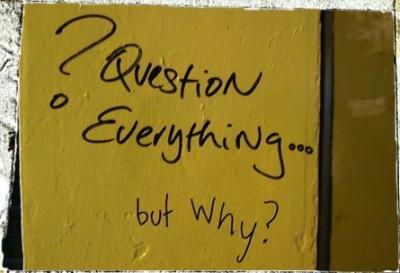
Question Everything

Sunshine on Discovery Bay

Sunshine on Discovery Bay
As always, the photos we use are either my own, or in the public domain. Please let me know if there are any errors and I'll correct them immediately.