Showing posts with label Yellowstone Quake Swarm. Show all posts

Sunday, January 31, 2010

Second-most numerous quake swarm hits Yellowstone

I normally wouldn’t put a second link to this item I write about a few  days ago, but it does give some hint as to the lag between someone who watches the NEIC (National Earthquake Information Center) email alerts for activity, and how long it takes media outlets to become interested.  So far, there are four that have shown interest in this year’s Quake Swarm.  Again, it may be nothing much at all.  Or, it could be the start of something big…MB

More than 1,200 tiny quakes hit Yellowstone Park, but jitters are few

Tuesday, January 19, 2010

Recent Earthquakes for Yellowstone

If you recall last January I mentioned the more frequent than typical quake swarms happening then in the area around Yellowstone Lake.  It is likely nothing, but isn’t it interesting that in January of this year we see another increase above typical frequency levels.  In this swarm of 46 quakes since January 13, 2010, as you can see from the map the activity is located well to the west of the area of Yellowstone Lake and the ground rise phenomenon under the lake.  This series of small quakes are centered in the area of Buffalo Meadows quadrant on topographical maps.  

Recent Earthquakes for Yellowstone

http://www.trails.com/topo_beta.aspx?lat=44.56213&lon=-110.97427&s=100&size=s

Sunday, January 04, 2009

Yellowstone Quake Swarm Update 10

There really isn't news to report about the series of earthquakes that had been occurring at Yellowstone Park for the last week.  The news is really that after over 500 earthquakes in a very small area over the course of six-plus days, there have been none since yesterday just after midnight (approaching two days ago, actually). 

A very quiet earthquake list for the Yellowstone Lake area

smith.jpg

Dr. Robert B. Smith, Research Professor of Geology & Geophysics at the University of Utah, and Director of the Yellowstone Volcano Observatory  Dr. Robert Smith bio

I'll be looking for interpretation from Dr. Smith and the team that has been studying the Yellowstone volcano system for many years, because even to them this was a unique event.  To me it felt very much like the magma chamber beneath Lake Yellowstone had either swollen or broken through a barrier and was moving to the Northeast during this period.  The webcorder movements were really hectic and seemed to show almost constant vibration in the area - and contrary to some web posters beliefs, this could not be accounted for by wind or other phenomena as the sensors are buried in specially designed borings several hundred feet down.  Even Katrina couldn't tweak those gauges!  Almost as suddenly as it had started, the swarm stopped, as if the moving magma had finally come up against a barrier that it didn't break through or move around.  Fortunately, this movement seems to have been achieved without creating a steam vent - which would likely have triggered at the least a geothermal explosion and at worst a supervolcanic eruption. 

The most fascinating thing about this was that it was clearly an event which was unprecedented - not in history, but in the recorded experience of human beings.  Even the best qualified people had no real way to predict what the activity meant - they could only rely on statistical likelihood based on historical events to discuss what may happen next.  Of the five things Dr. Smith had mentioned leading up to a hydrothermal explosion or supervolcanic eruption, four were present in this case.  The only one that was not noted was an increase in volcanic gasses.  Who knows if the magma movement was more or less routine and the magma was simply able to move more rapidly than is typical through an area where there was minimal resistance, until a after nearly a week a more formidable barrier was finally encountered?  Will this be the end of the quake swarm, or will it resume in the near future and continue for weeks, as some do?  Could these quakes have created new tension instead of releasing it, and a large quake be next?  Might the magma again break through and trigger an explosive event?  I really don't think that, beyond knowing the relative historical frequency of each type of event, anyone can really say what this all means, or what will happen next. 

My smallish mind interpreted what I was seeing and reading as magma movement-related, but that wasn't how Dr. Smith and his colleagues were seeing the same information.  According to Dr. Smith, the earthquake swarm was more of a major seismic event rather than a major volcanic event.   That is, it was related to faults and plate movements mostly and NOT to magma movement.  If anyone is one the fence on this, I say GO WITH THE GUY WHO HAS SPENT 30+ YEARS STUDYING YELLOWSTONE!  Still, I am eager to see anything they come up with concerning this event. And I'll be sure to post whatever I do find, so stay tuned.

Saturday, January 03, 2009

Yellowstone Quake Swarm Update 9

Today has continued calm around Yellowstone Lake.  There has been just one earthquake today, just after midnight, and the ground shaking on the webcorders maintained by the University of Utah have also shown dramatically reduced activity.  This could indicate that the movement of magma underground has stopped, possibly due to blockage.  The most recent quakes were all at the northeast end of the lake, though, just where many of the largest hydrothermal explosions have occurred in the past - creating Mary Bay among many other features.  Time will tell if this calm represents the end of the swarm, or something else.  I'll post more updates if events warrant. 

wyoming-old-faithful


Friday, January 02, 2009

Yellowstone Quake Swarm Update 8

Things seem to be quieter this evening, perhaps following a pattern that has been ongoing since the swarm began - very active periods followed by calm periods.  We'll see if things get busy again by morning.  In the meantime, there was finally an update from Dr. Smith, reported by www.kutv.com...:

"By Friday, January 2nd, Smith said over 500 tremors had been recorded around the north end of Yellowstone Lake. The biggest quake was a magnitude 3.9 - not big enough to cause damage. “This is a big deal”, said Smith, who has been studying the volcanic and geothermal activity at Yellowstone for over 30 years. There have been clusters, or “swarms” of quakes at Yellowstone before, but not this many for this long says Smith. “What’s important about them is that this is not normal, not usual to have these longer swarms so we pay particular scientific attention to them in terms of how they might relate to faults or to geysers or other hydrothermal features,” said Smith. "

Yellowstone Quake Swarm Update 7

The earthquakes continue again today for the sixth day at Yellowstone.  Since midnight there have been nine quakes, and three greater than 3.1 magnitude.  The webcorders continue to show near constant ground movement, and it is possible that there have been more than these nine reported events as the seismologist reviews have been taking a while with so many events to review.  As of this morning there are 330 quakes shown on the list since last Saturday, but I notice that events that occurred yesterday are being added today, and the Yellowstone Volcano Center indicated that there have been over 400 yesterday, so that number could be much higher.  This morning's two most recent quakes - a 3.6 and a 3.1 - were located right at the north end of the lake.  The last two quakes were not only larger than normal in the swarm, but they were even closer to the surface - .18 kilometers and .1 kilometers.  This very shallow activity is what has me wondering if there will be a hydrothermal explosion.

Norris Geyser Basin in Winter

From the US News blog on this event - quoting an email from a Splunk member who crunched the numbers:

"I'm sending you this email with some information I've gleaned from the USGS archives.  I'm analyzing the ANSS data (http://www.ncedc.org/cnss/) in an install of Splunk, which is a timeline based search and reporting engine.  I have 30 years of data in the system, with about 2M quakes total. 
Using  the ANSS data, I discovered the number of 2.5 or higher quakes in the *general* Yellowstone area for the decade of the 1980s was 128.  The number of 2.5 or higher quakes for the region directly around the lake in the *last 4 days* was 30. 
Again, for 2.5 mag or greater quakes:
Entire region of Yellowstone for 10 years = 128 quakes
Area just around Yellowstone Lake last 4 Days = 30 quakes
The entire 1980s of 2.5 or higher quakes in the vicinity of the lake was a paltry 4 quakes.  Doing a quick back of the envelope calculation using the number of quakes and the intensities, the  activity over the last 4 days has released roughly 100x the amount of energy released in the entire 1980s for the same general region.  In the last week alone there have been 10 quakes of magnitude 3.0 or greater around the lake, with one as high as 3.8."

Links:

US News Blog discussing the past frequency of quakes

Illustration of the current Quake Swarm at Yellowstone

NEIC Earthquake List

Animation map

These show the webcorders just minutes ago - more jumps:

www.quake.utah.edu...

Thursday, January 01, 2009

Yellowstone Quake Swarm Update 6

There is a new statement from the Yellowstone Volcano Observatory tonight.  One interesting item to be gleaned is that though scientists have been reviewing the many quakes as rapidly as possible, they are at a point where they've only been able to analyze the larger quakes in the swarms, and have a backlog of as many as 400 events in the series yet to evaluate.  That is quite a backlog, and as long as the quake activity remains anywhere near the volume of the last five days, the backlog will only grow. 

Using the guarded language one would expect, the statement indicates that scientists are considering the possibility of hydrothermal explosions, or less likely, volcanic events, but it reads to me that they simply don't have the data available to predict what the follow on might likely be, and therefore rely on the statistically small likelihood that this is anything other than a larger than normal, longer than normal series of quakes.  Only time will tell. 

"The December 2008 earthquake sequence is the most intense in this area for some years. No damage has been reported within Yellowstone National Park, nor would any be expected from earthquakes of this size. The swarm is in a region of historical earthquake activity and is close to areas of Yellowstone famous hydrothermal activity. Similar earthquake swarms have occurred in the past in Yellowstone without triggering steam explosions or volcanic activity. Nevertheless, there is some potential for hydrothermal explosions and earthquakes may continue or increase in magnitude. There is a much lower potential for related volcanic activity."

Links:

http://earthquake.usgs.gov/eqcenter/recenteqsus/

http://www.seis.utah.edu/

http://www.quake.utah.edu/helicorder/heli/yellowstone/index.html

http://volcanoes.usgs.gov/yvo/

http://pboweb.unavco.org/shared/scripts/stations/?checkkey=WLWY&sec=timeseries_plots&timeseries=raw


Yellowstone Quake Swarm Update 5

The number of quakes has declined significantly today, and the webcorders are also showing reduced activity.  This may be the point where the event calms down, or it could be similar to Monday night, when the activity quieted down only to become even more active on Tuesday morning.  We'll see over the next twelve hours or so.  It could also be a precursor to a larger quake like the Hebgen Lake Quake, as there was a swarm followed by relative calm just prior to that event.  Of course, the un likely eruption or hydrothermal explosion is still a possibility,  Finally, the event could go on for weeks, according to Dr. Smith of the University of Utah.  Still no updates from Dr. Smith or his team and it has been since Monday.  The Salt Lake City station KSL reported yesterday that he is in Yellowstone himself monitoring events.  I suppose an update would be unsatisfying anyway, because it would likely include just basic information as it is clear from his earlier comments and follow-up with KSL that the geophysical world just has no data on how supervolcanoes behave prior to eruption or even large hyrdothermal explosions.  This means that many of us will continue to monitor the webcorders, USGS and U of U quake report pages to see what comes next.  Hopefully this will just be an interesting anomalous series of quakes and nothing more.  Hopefully.

The following US Geological Survey chart shows prior supervolcano activity in graphic form for reference on the relative size of the Yellowstone system:

Supervolcano eruption chart

Yellowstone Quake Swarm Update 4

The earthquakes continue this morning with ten quakes since midnight in the area of Yellowstone Lake.  This is a slower pace than we've seen, but the live webcorders seem to indicate a lot of harmonic activity continuing as well.  And the quakes have come in groups  with gap intervals over the past few days, so we'll have to see how day 5 finishes.  Here is the latest activity:

January 1, 2008 12:51 PM Earthquake List

Interesting Related Links:

Yellowstone Rising

Yellowstone Rising Map

3D Map of Yellowstone Magma Chamber

US News Interview with Chief Scientist at Yellowstone

Wednesday, December 31, 2008

Yellowstone Quake Swarm Update 3

It is interesting to note how much the ground deformation change instruments are indicating that the surface is rising at an increased rate in the area of the microquakes.  Does this, combined with the continued quakes under the area of the dome, and the area where most hydrothermal explosions have occurred indicate something is brewing?  I don't know, and I don't think the scientists know either.  It is somewhat strange that Dr. Smith has made no comments again today despite increasing focus on the phenomena.  Strange, but not necessarily meaningful.  Necessarily. 

Time Series Unfiltered Plot for WLWY


Here are today's quakes at the north end of Yellowstone Lake:

 MAG    DATE    LOCAL-TIME  LAT     LON    DEPTH    LOCATION
y/m/d h:m:s deg deg km


 2.1  2008/12/31 22:29:09 44.507N 110.309W  1.5   64 km (40 mi) SSW of  Cooke City-Silver Gate, MT
2.2 2008/12/31 22:19:51 44.509N 110.350W 1.7 62 km (39 mi) ESE of West Yellowstone, MT
1.5 2008/12/31 08:05:00 44.514N 110.360W 1.1 61 km (38 mi) ESE of West Yellowstone, MT
3.3 2008/12/31 08:02:11 44.523N 110.361W 4.9 61 km (38 mi) ESE of West Yellowstone, MT
1.5 2008/12/31 05:50:01 44.518N 110.368W 2.0 61 km (38 mi) ESE of West Yellowstone, MT
1.1 2008/12/31 05:46:53 44.520N 110.362W 2.0 61 km (38 mi) ESE of West Yellowstone, MT
1.9 2008/12/31 05:42:06 44.519N 110.367W 0.1 61 km (38 mi) ESE of West Yellowstone, MT
1.6 2008/12/31 05:26:56 44.501N 110.385W 2.2 60 km (37 mi) ESE of West Yellowstone, MT
1.4 2008/12/31 05:23:52 44.520N 110.371W 1.0 60 km (37 mi) ESE of West Yellowstone, MT
1.7 2008/12/31 04:52:19 44.503N 110.371W 0.4 61 km (38 mi) ESE of West Yellowstone, MT
1.3 2008/12/31 04:40:04 44.526N 110.368W 2.2 60 km (38 mi) ESE of West Yellowstone, MT
1.6 2008/12/31 04:25:24 44.516N 110.376W 1.8 60 km (37 mi) ESE of West Yellowstone, MT
1.4 2008/12/31 04:25:11 44.523N 110.364W 2.2 61 km (38 mi) ESE of West Yellowstone, MT
1.4 2008/12/31 04:22:16 44.520N 110.382W 2.2 59 km (37 mi) ESE of West Yellowstone, MT
2.7 2008/12/31 04:15:44 44.522N 110.372W 1.2 60 km (37 mi) ESE of West Yellowstone, MT
1.5 2008/12/31 04:12:40 44.516N 110.373W 0.6 60 km (37 mi) ESE of West Yellowstone, MT
1.8 2008/12/31 04:08:59 44.532N 110.381W 0.4 59 km (37 mi) ESE of West Yellowstone, MT
0.6 2008/12/31 04:08:34 44.527N 110.367W 2.1 60 km (38 mi) ESE of West Yellowstone, MT
2.4 2008/12/31 04:06:14 44.520N 110.371W 1.2 60 km (37 mi) ESE of West Yellowstone, MT
1.9 2008/12/31 04:05:12 44.532N 110.380W 0.3 59 km (37 mi) ESE of West Yellowstone, MT
1.3 2008/12/31 03:53:29 44.520N 110.364W 2.2 61 km (38 mi) ESE of West Yellowstone, MT
0.9 2008/12/31 03:52:59 44.504N 110.381W 2.1 60 km (37 mi) ESE of West Yellowstone, MT
1.5 2008/12/31 03:52:23 44.546N 110.394W 0.7 58 km (36 mi) ESE of West Yellowstone, MT
1.9 2008/12/31 03:43:37 44.524N 110.372W 1.5 60 km (37 mi) ESE of West Yellowstone, MT
0.9 2008/12/31 03:26:38 44.523N 110.367W 0.0 61 km (38 mi) ESE of West Yellowstone, MT
1.1 2008/12/31 03:26:01 44.532N 110.381W 2.0 59 km (37 mi) ESE of West Yellowstone, MT
1.8 2008/12/31 03:23:43 44.530N 110.380W 1.0 59 km (37 mi) ESE of West Yellowstone, MT
1.2 2008/12/31 03:23:07 44.529N 110.380W 0.9 59 km (37 mi) ESE of West Yellowstone, MT
1.5 2008/12/31 03:21:49 44.521N 110.373W 2.1 60 km (37 mi) ESE of West Yellowstone, MT
1.4 2008/12/31 03:16:44 44.527N 110.367W 0.8 60 km (38 mi) ESE of West Yellowstone, MT
3.6 2008/12/31 02:02:28 44.525N 110.362W 4.3 61 km (38 mi) ESE of West Yellowstone, MT
3.0 2008/12/31 01:58:11 44.527N 110.369W 1.3 60 km (37 mi) ESE of West Yellowstone, MT
3.3 2008/12/29 12:14:49 44.521N 110.369W 1.8 60 km (38 mi) ESE of West Yellowstone, MT


Yellowstone Quake Swarm Update 2


The scale on this is eight miles on a side, and the diagram is courtesy of a discussion board member called Shirakawa.  This represents the magnitude, depth and location of the earthquakes in this series of quakes beneath the North end of Yellowstone Lake.

A correction of an earlier comment on hydrothermal explosions : "an explosion 13,800 years ago left a 5 kilometer diameter crater at Mary Bay on the edge of Yellowstone Lake (located in the center of the caldera)." --FEMA Region VIII statement issued today.

Updated Map and listing of quakes at Yellowstone this week (incomplete as there are so many quakes that seismologist review is taking up to a day): Recent Yellowstone Quakes

The swarm has reintensified today after a slight drop in activity yesterday.  It is interesting to note that the quakes continue to occur in the area of Yellowstone Lake beneath the dome on the lake's floor, and in the vicinity of most of the hydrothermal explosions on record.  Like most people watching this interesting swarm, I'd love to hear from the U of U director, even if they aren't clear about what the quakes mean, to get an idea of what they are thinking.  Still, I guess they cannot speculate too much, as spooking people would be a bad thing to do.  So, we wait, watch and will see...

Yellowstone Earthquake Swarm Update

Others

Illustration of a Yellowstone eruption from the Discovery Channel/BBC co-production 'Supervolcano'.

The small earthquakes are continuing today in the caldera at Yellowstone National Park, with a couple of mid-sized events near and above 3:

Recent Quake List 

Yellowstone Quake Map

It is clear that no one is sure what, if any larger significance these events will have, in terms of a volcanic or hydrothermal event, but geophysicists and geologists are keeping close watch.  FEMA has announced that it is monitoring the events.  Why?  Well, it is possible that the tremors are a precursor to an eruption, though the odds are low, as such events occur only every 600,000 years, or so.  Still, it has been approximately 640,000 years since the last supervolcano eruption at Yellowstone, and even events that happen only rarely all happen at a precise moment in time. 

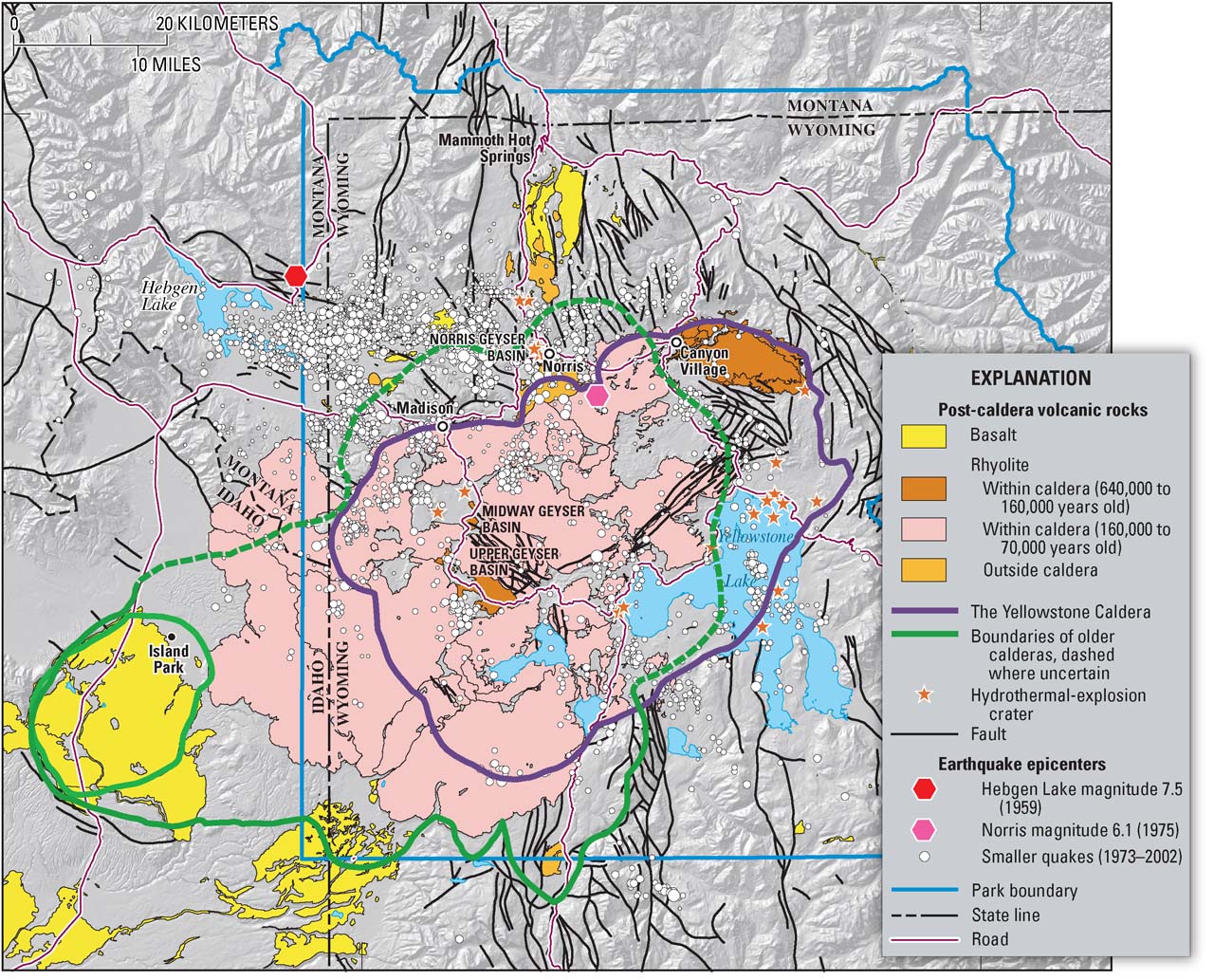
Another possibility, and one more likely, it appears, is for a hydrothermal explosion.  This occurs much more frequently and can vary widely in size.  A hydrothermal explosion occurs when superheated water finds it's way to the surface and the reduced pressure creates an explosive release.  There are ten of these craters at Yellowstone, and they vary widely in size.  Debris can be thrown hundreds of feet to tens of miles in such explosions.  It is interesting to note that the cluster of small quakes now underway in Yellowstone are all in an area at the Northern end of Yellowstone Lake, the same area where most of the hydrothermal explosions in the Park have occurred over time (look for the stars in this map):

Yellowstone Volcanic Events Map

Streaming video of Old Faithful: Old Faithful Webcam Streaming Live

So, just what kind of event is about to happen, if any?  Most people's gut reaction is probably right - that is, to have a passing thought about cataclysm, think twice about going for a snowmobile run around Yellowstone Lake, and go on with a regular day.  Without 'showing your work' as math teachers like to say, this thought process reflects complex math and risk assessment.  That is, it gives weight to each of the several possibilities approximately according to their likely occurrence. 

The story has begun to get press- after four days - worldwide, but still the only comments from Dr. Smith for the record are from Monday morning, and tell us that this is unusual and we don't know what it may indicate.

If you're interested in the seismograph images for the area: University of Utah Seismograph Webcorders

If you're interested in a visual interpretation of the quake swarm check out:  Yellowstone Earthquake Swarm December 2008

If you'd like to investigate the dome-building activity go here: Yellowstone ground deformation data

Additional links:

Volcanic Locations near Yellowstone Lake

US News Article with discussion of supervolcano intensity scale

Google Blog Search for Yellowstone Quake Swarm

Google News Search

Geologic History of Yellowstone and Direction of North American Plate Movement

Sunshine on Discovery Bay

Sunshine on Discovery Bay
As always, the photos we use are either my own, or in the public domain. Please let me know if there are any errors and I'll correct them immediately.