Showing posts with label Global warming. Show all posts

Friday, January 01, 2010

No rise of atmospheric carbon dioxide fraction in past 160 years, new research finds

I would love to have this explained to me in accessible, non-condescending terms that my small brain can digest.  It looks like this is saying that the earth’s ability to absorb the same percentage of produced Co2 has remained unchanged over the past century and a half.  Is this a meaningful number if total Co2 produced has risen significantly?  That is, if oceans and plants are consuming 55% of the carbon dioxide produced, and have been for at least the past century and a half,  then that either means that the total amount produced is rising due to human activity and though the percentage absorbed is constant, the rising volume means rising total levels.  Is this then going to produce anomalies in the models used to predict climate change – anomalies tending toward overstating warming?  Looking forward to your comments!

No rise of atmospheric carbon dioxide fraction in past 160 years, new research finds

Wednesday, December 02, 2009

Daniel Henninger: Climategate: Science Is Dying - WSJ.com

Interesting commentary by Daniel Henninger in the WSJ.  The shabby aspects of ‘climategate’ seem to deal more in attempts to block dissidents from publication and tricking numbers to manipulate them into being ‘right’ – that is, to reflect what the scientist in question assumed they would.   The shoddy behavior of a few scientists does not change the facts.  Whether the planet is warming, and whether the cause is human activity or not is not changed by a small group of ‘scholars’ attempting to trick the numbers or keep others who disagree from publishing.  Henninger refers to Gallileo, and it doesn’t seem that much of a stretch to see global warming driven by human activity as an article of faith which must be served if one wishes to prosper in scientific endeavors.  Scientists are called to a higher discourse and regard for free exchange of information and ideas.  Though it does not change whether the earth is warming due to our activities or not, the behavior of our scientific community does bear on not only this question but the whole of scientific discourse.  IMO.

Daniel Henninger: Climategate: Science Is Dying - WSJ.com

Sunday, October 11, 2009

BBC NEWS | Science & Environment | What happened to global warming?

This is an interesting article from BBC News concerning the correlation between various potential causes of temperature change, and the fluctuations in global temperature in recent years.  This article discusses solar cycles, the impact of changing ocean temperatures on surface temperatures, and other contributors to climate change.  Temperatures have been declining since 1998, and this article looks at what that says about global warming. 

This headline may come as a bit of a surprise, so too might that fact that the warmest year recorded globally was not in 2008 or 2007, but in 1998.

But it is true. For the last 11 years we have not observed any increase in global temperatures.

And our climate models did not forecast it, even though man-made carbon dioxide, the gas thought to be responsible for warming our planet, has continued to rise. “

BBC NEWS | Science & Environment | What happened to global warming?

Tuesday, June 30, 2009

Echoes of Past Complaints

One of the many issues over which the Bush Administration was criticized heavily (and probably rightly so) for was suppressing information and opinions in the EPA whish disagreed with the administration’s policy.  That’s okay in many management settings, but I hate to see it when what is being curtailed is not merely points of view in conflict with chosen policy, but scientific discussion and debate.  In the case of the Bush Administration it seems clear that data which did  not support the administration's skepticism of global warming and human-based causes of warming.  Now it seems that the Obama Administration is doing the same thing, albeit the data being suppressed is in conflict with the administration’s view that earth is warming and human activity is driving it.  At the EPA, a 38 year veteran researcher concluded that the earth is probably not warming and may actually be cooling.  He also wrote that it is probably not necessary to regulate carbon dioxide emissions at this point.  He actually sees signs that earth is cooling recently and may be back to mid-20th century levels.  You can read more about the censoring of his report and the details of its’ content here:  http://news.cnet.com/8301-13578_3-10274412-38.html

If it is bad for one administration to suppress research that opposes its’ policies, it is bad for all administrations to do so.  Far better to consider and reply to such research than just to try and quash it – which seldom works anyway.

Sunday, January 04, 2009

Colder Weather Spurs Late Revival of Arctic Ice

Arctic Research Center:  Sea Ice Ends Year at Same Level as 1979
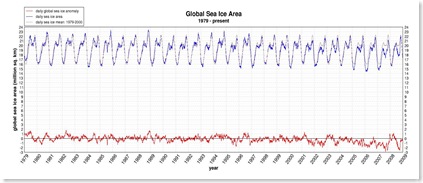
9972_large_daily_gsia


  "Thirty years of sea ice data. The record begins at 1979, the year satellite observations began (Source: Arctic Research Center, University of Illinois)

Thanks to a rapid rebound in recent months, global sea ice levels now equal those seen 29 years ago, when the year 1979 also drew to a close. "        

--Michael Asher (Blog) - January 1, 2009  Link to full entry


Arctic sea ice decreased significantly through much of last year, but satellite data shows the trend was reversed late in the year, with the rate of increase from September to year end showing the fastest rate of change on record - either for rate of increase or rate of decrease.  According to the University of Illinois's Arctic Climate Research Center as reported in the Dailytech.com blog above, the information is collected via satellite observation of the Northern and Southern hemisphere polar regions.  This is the method used to calculate snow cover data as well.

Sea ice is a very useful indicator of short-term trends because it forms and melts much more quickly than the huge and thick ice sheets anchored to bedrock in Antarctica and around the Arctic Circle.  In the last quarter of 2008, the thinner sea ice had less snow cover than the ice sheets to insulate it from the bitterly cold air, and therefore grew much faster than expected, according to the National Snow and Ice Data Center.

The Arctic Research Center report (Arctic Research Center Website) uses a system based upon the mean ice anomaly - a measurement which reflects the difference between the current sea ice value and the mean sea ice value for the period between 1979 and 2000 (1979 is the year satellite data first began to be used for this purpose).  The above image shows the mean sea ice anomaly value at near 1, about where it was in 1979.  Note that as late as September the word "unprecedented" was frequently being attached to predictions of low sea ice levels:

http://geology.com/news/2008/arctic-sea-ice-levels.shtml

arctic-sea-ice-in-death-spiral-second-lowest-on-record

http://news.cnet.com/8301-17912_3-10043977-72.html

This is just one of the many ways that science continues to learn about the processes, causes and effects, and the historical record for climate related processes on earth.  Because the record is so complex, it can be very difficult to model the future based on data from multiple and variable sources, collected by different means and over a very short period of time, in terms of the planetary history.  Clearly, science does not yet understand all of the earth's processes or the complex interrelationships that drive them. 

By way of disclaimer, though, please note that merely publishing reports that do not conform to global warming doctrine at face value does not in any way indicate that I am a denier.  I am uncomfortable with many definitive statements that are made concerning earth processes for which we have only cursory and recent data to interpret.  However, that does not mean that we should conduct ourselves as if our activities have no impact on the planet.  Clearly they do, and to whatever extent science ultimately demonstrates, human actions are wasteful and have an unnecessary impact on the ecosystems and processes of the planet.  I prefer to take a logic-based approach in this case rather than an empirical approach where facts are tough to demonstrate.  The logic-based approach, as I see it (and no doubt Gifford Pinchot would concur), is simply to conserve our natural resources, minimize the footprint of humans to the greatest practical degree, and to conduct our future designs, economy and collective lifestyle with as great an emphasis on preserving the natural processes and resources of the earth as we can manage.  By taking this approach, the objective of the current global warming proponents can be met without the need of introducing political agenda and public relations into the scientific process.  The need to prove that each wasteful or polluting activity is having grave consequences right now is moot, if the guiding principal is conservation. 

Oh, and yes, I realize that is idealistic.  Once we have uniformly adopted conservation I propose we move on to world peace. 

Thursday, January 01, 2009

Lowest Sunspot Activity Since 1900 Tied to Temperature Drop Over the Past Two Years?

The average temperature on earth has declined over the past two years by about half a degree Celsius - an amount that similar to the temperature increases reported over the past century.  This year may be the coldest on record in the past century.  All four major global temperature tracking outlets (Hadley, NASA's GISS, UAH, RSS) reported that during the period of January 2007 to January 2008, global temperatures have dropped significantly.   2008 has set a number of records for cold and snowfall.  In the U.S., NOAA recorded over 60 local snowfall records and more than 100 all-time low temperatures for the month of October.

This cooling trend - whatever its cause - was not predicted by climate models.  It was, however, predictable, at least according to some scientists who study sunspot activity.  Since 2000, sunspot activity has been in decline, and this year sunspot activity has matched an inactivity level not seen since the early 1900s.  The sunspot activity on the sun ordinarily follows an 11 year cycle where the activity peaks and then slows.  It isn't unusual to record 100 sunspots in a single month, and then as then cycle winds down, the number can decline to near zero.  Typically, a new cycle begins fairly quickly, but not this year.  Through July of this year the average monthly total  was three, and in August there were none recorded. 

According to the publication Daily Tech, over the last 1,000 years, there have been three previous similar events — known as the Dalton, Maunder and Sporer Minimums.  These events have each corresponded to rapid cooling. The largest came to be known as the Little Ice Age (1500-1750).  Geoscientists have found excellent correlations between periods of warming and cooling on earth and sunspot activity. 

sunclimate_3b

http://www.oar.noaa.gov/spotlite/archive/spot_sunclimate.html

http://www.physicalgeography.net/fundamentals/7y.html

That is not to say that human activity is a non-contributor to global climate.  But it is interesting to note the sunspot activity and the apparent correlation to global temperatures.  It will be interesting and to see if this period of cooling is prolonged, and should it be, may be a hidden benefit in that it may offset some of the climate change predicted to occur in the next century, giving us an extension that seems to be much needed in reducing the impact of human activity on climate.

Thursday, October 30, 2008

MIT scientists baffled by global warming theory, contradicts scientific data

from Trendwatch

By Rick C. Hodgin

Thursday, October 30, 2008 09:55

Boston (MA) - Scientists at MIT have recorded a nearly simultaneous world-wide increase in methane levels. This is the first increase in ten years, and what baffles science is that this data contradicts theories stating man is the primary source of increase for this greenhouse gas. It takes about one full year for gases generated in the highly industrial northern hemisphere to cycle through and reach the southern hemisphere. However, since all worldwide levels rose simultaneously throughout the same year, it is now believed this may be part of a natural cycle in mother nature - and not the direct result of man's contributions.
Methane - powerful greenhouse gas
The two lead authors of a paper published in this week's Geophysical Review Letters, Matthew Rigby and Ronald Prinn, the TEPCO Professor of Atmospheric Chemistry in MIT's Department of Earth, Atmospheric and Planetary Science, state that as a result of the increase, several million tons of new methane is present in the atmosphere.
Methane accounts for roughly one-fifth of greenhouse gases in the atmosphere, though its effect is 25x greater than that of carbon dioxide. Its impact on global warming comes from the reflection of the sun's light back to the Earth (like a greenhouse). Methane is typically broken down in the atmosphere by the free radical hydroxyl (OH), a naturally occuring process. This atmospheric cleanser has been shown to adjust itself up and down periodically, and is believed to account for the lack of increases in methane levels in Earth's atmosphere over the past ten years despite notable simultaneous increases by man.  Continue reading article here

Sunshine on Discovery Bay

Sunshine on Discovery Bay
As always, the photos we use are either my own, or in the public domain. Please let me know if there are any errors and I'll correct them immediately.