Showing posts with label Earth temperature changes. Show all posts

Friday, August 27, 2010

Massive solar storm to hit Earth in 2012 with 'force of 100m bombs' - Yahoo! India News

The current wave of “Mega-disaster” (after all, would people really watch tv shows and news reports if they were only reporting regular old disasters?) programs, books, articles and the now ubiquitous “internet chatter”, can now add to it this forecast for a very significant solar storm in 2012.  With space junk, magnetic pole reversal, asteroid and meteor and all the usual possible disasters that are possible, it surely seems that I might want to pull a Rip Van Winkle and snooze for the year in2012.

Massive solar storm to hit Earth in 2012 with 'force of 100m bombs' - Yahoo! India News

Technorati Tags: ,,

Friday, January 01, 2010

No rise of atmospheric carbon dioxide fraction in past 160 years, new research finds

I would love to have this explained to me in accessible, non-condescending terms that my small brain can digest.  It looks like this is saying that the earth’s ability to absorb the same percentage of produced Co2 has remained unchanged over the past century and a half.  Is this a meaningful number if total Co2 produced has risen significantly?  That is, if oceans and plants are consuming 55% of the carbon dioxide produced, and have been for at least the past century and a half,  then that either means that the total amount produced is rising due to human activity and though the percentage absorbed is constant, the rising volume means rising total levels.  Is this then going to produce anomalies in the models used to predict climate change – anomalies tending toward overstating warming?  Looking forward to your comments!

No rise of atmospheric carbon dioxide fraction in past 160 years, new research finds

Thursday, November 19, 2009

Stagnating Temperatures: Irony puts a Silly Hat on Yet Another Global Climate Change Summit

Okay, so if I haven’t bored you with my lame metaphysical theory before, lucky you.  But not that lucky, as I will do it now.  After observing the world, the way it works, the way we interact; in fact the sum total of my education and experience from birth to the moment of epiphany went into this theory:  At the root, at the smallest possible level, we will someday learn that the universe and all of its’ components are built of this basic material.  What is it?  Irony.  Yes, irony.  Look closely enough at almost any situation and one finds irony of varying degrees.  For example, let’s say you were going to have a global summit to face the crisis of global warming.  You were going to invite Prince Charles to repeat his prediction of immanent disaster if we don’t reduce greenhouse gases dramatically this year.  Let’s say you are planning to press national governments to enact and enforce emissions standards projected to cost hundreds of billions of dollars at a time when the global economy is teetering on the brink of a huge depression.  What would be ironic, in this situation?  I think the subject of the following article does the trick nicely in showing us the irony of which we are all assembled.  According to this Spiegel article (and many other reports in news sources, journals and science magazines as well), the earth has stopped warming.  Just in time to make the people who have been predicting catastrophe look a bit silly and alarmist.  Whether you attribute this phenomena of stagnated temperatures to ocean current patterns, or the historic low levels of sunspot activity since 2000, you must admit that I may be right.  Irony might be the cause of the whole thing.

Stagnating Temperatures: Climatologists Baffled by Global Warming Time-Out - SPIEGEL ONLINE - News - International

Sunday, October 11, 2009

BBC NEWS | Science & Environment | What happened to global warming?

This is an interesting article from BBC News concerning the correlation between various potential causes of temperature change, and the fluctuations in global temperature in recent years.  This article discusses solar cycles, the impact of changing ocean temperatures on surface temperatures, and other contributors to climate change.  Temperatures have been declining since 1998, and this article looks at what that says about global warming. 

This headline may come as a bit of a surprise, so too might that fact that the warmest year recorded globally was not in 2008 or 2007, but in 1998.

But it is true. For the last 11 years we have not observed any increase in global temperatures.

And our climate models did not forecast it, even though man-made carbon dioxide, the gas thought to be responsible for warming our planet, has continued to rise. “

BBC NEWS | Science & Environment | What happened to global warming?

Sunday, January 04, 2009

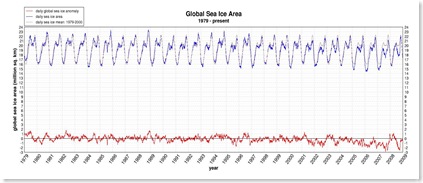
Colder Weather Spurs Late Revival of Arctic Ice

Arctic Research Center:  Sea Ice Ends Year at Same Level as 1979
9972_large_daily_gsia


  "Thirty years of sea ice data. The record begins at 1979, the year satellite observations began (Source: Arctic Research Center, University of Illinois)

Thanks to a rapid rebound in recent months, global sea ice levels now equal those seen 29 years ago, when the year 1979 also drew to a close. "        

--Michael Asher (Blog) - January 1, 2009  Link to full entry


Arctic sea ice decreased significantly through much of last year, but satellite data shows the trend was reversed late in the year, with the rate of increase from September to year end showing the fastest rate of change on record - either for rate of increase or rate of decrease.  According to the University of Illinois's Arctic Climate Research Center as reported in the Dailytech.com blog above, the information is collected via satellite observation of the Northern and Southern hemisphere polar regions.  This is the method used to calculate snow cover data as well.

Sea ice is a very useful indicator of short-term trends because it forms and melts much more quickly than the huge and thick ice sheets anchored to bedrock in Antarctica and around the Arctic Circle.  In the last quarter of 2008, the thinner sea ice had less snow cover than the ice sheets to insulate it from the bitterly cold air, and therefore grew much faster than expected, according to the National Snow and Ice Data Center.

The Arctic Research Center report (Arctic Research Center Website) uses a system based upon the mean ice anomaly - a measurement which reflects the difference between the current sea ice value and the mean sea ice value for the period between 1979 and 2000 (1979 is the year satellite data first began to be used for this purpose).  The above image shows the mean sea ice anomaly value at near 1, about where it was in 1979.  Note that as late as September the word "unprecedented" was frequently being attached to predictions of low sea ice levels:

http://geology.com/news/2008/arctic-sea-ice-levels.shtml

arctic-sea-ice-in-death-spiral-second-lowest-on-record

http://news.cnet.com/8301-17912_3-10043977-72.html

This is just one of the many ways that science continues to learn about the processes, causes and effects, and the historical record for climate related processes on earth.  Because the record is so complex, it can be very difficult to model the future based on data from multiple and variable sources, collected by different means and over a very short period of time, in terms of the planetary history.  Clearly, science does not yet understand all of the earth's processes or the complex interrelationships that drive them. 

By way of disclaimer, though, please note that merely publishing reports that do not conform to global warming doctrine at face value does not in any way indicate that I am a denier.  I am uncomfortable with many definitive statements that are made concerning earth processes for which we have only cursory and recent data to interpret.  However, that does not mean that we should conduct ourselves as if our activities have no impact on the planet.  Clearly they do, and to whatever extent science ultimately demonstrates, human actions are wasteful and have an unnecessary impact on the ecosystems and processes of the planet.  I prefer to take a logic-based approach in this case rather than an empirical approach where facts are tough to demonstrate.  The logic-based approach, as I see it (and no doubt Gifford Pinchot would concur), is simply to conserve our natural resources, minimize the footprint of humans to the greatest practical degree, and to conduct our future designs, economy and collective lifestyle with as great an emphasis on preserving the natural processes and resources of the earth as we can manage.  By taking this approach, the objective of the current global warming proponents can be met without the need of introducing political agenda and public relations into the scientific process.  The need to prove that each wasteful or polluting activity is having grave consequences right now is moot, if the guiding principal is conservation. 

Oh, and yes, I realize that is idealistic.  Once we have uniformly adopted conservation I propose we move on to world peace. 

Sunshine on Discovery Bay

Sunshine on Discovery Bay
As always, the photos we use are either my own, or in the public domain. Please let me know if there are any errors and I'll correct them immediately.